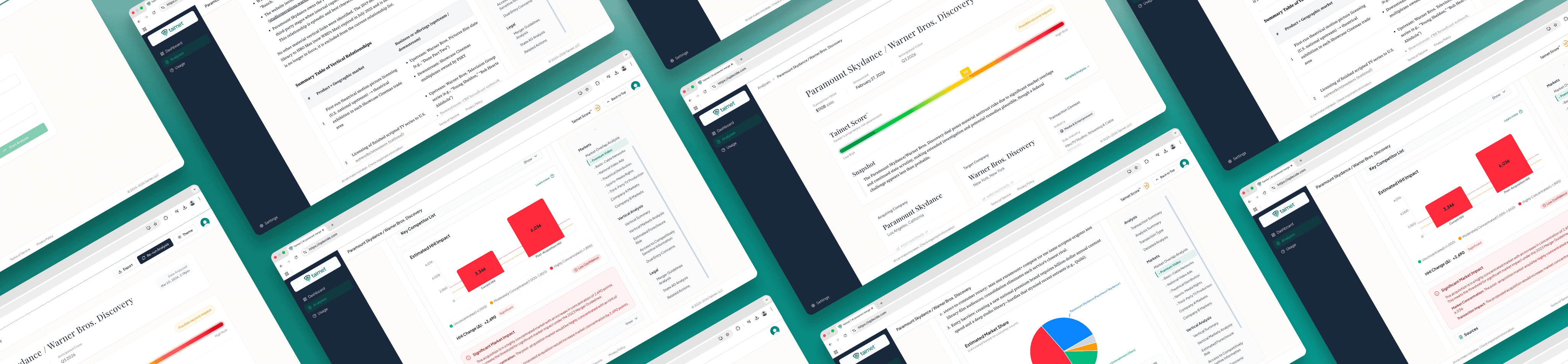
Taimet
Designing for trust in an AI startup making high-stakes legal predictions.
ROLE
Product Design Intern
AI trust framework
Score visualization
Progressive disclosure
Product storytelling visuals
AI trust evaluation + suggestions, score visualization improvements, progressive disclosure improvements, and product marketing visuals.
Solo designer; reported to founder, Ben Rugg
12 weeks
PROJECTS
DELIVERED
TIMELINE
TEAM
AI Trust

Data Visualization
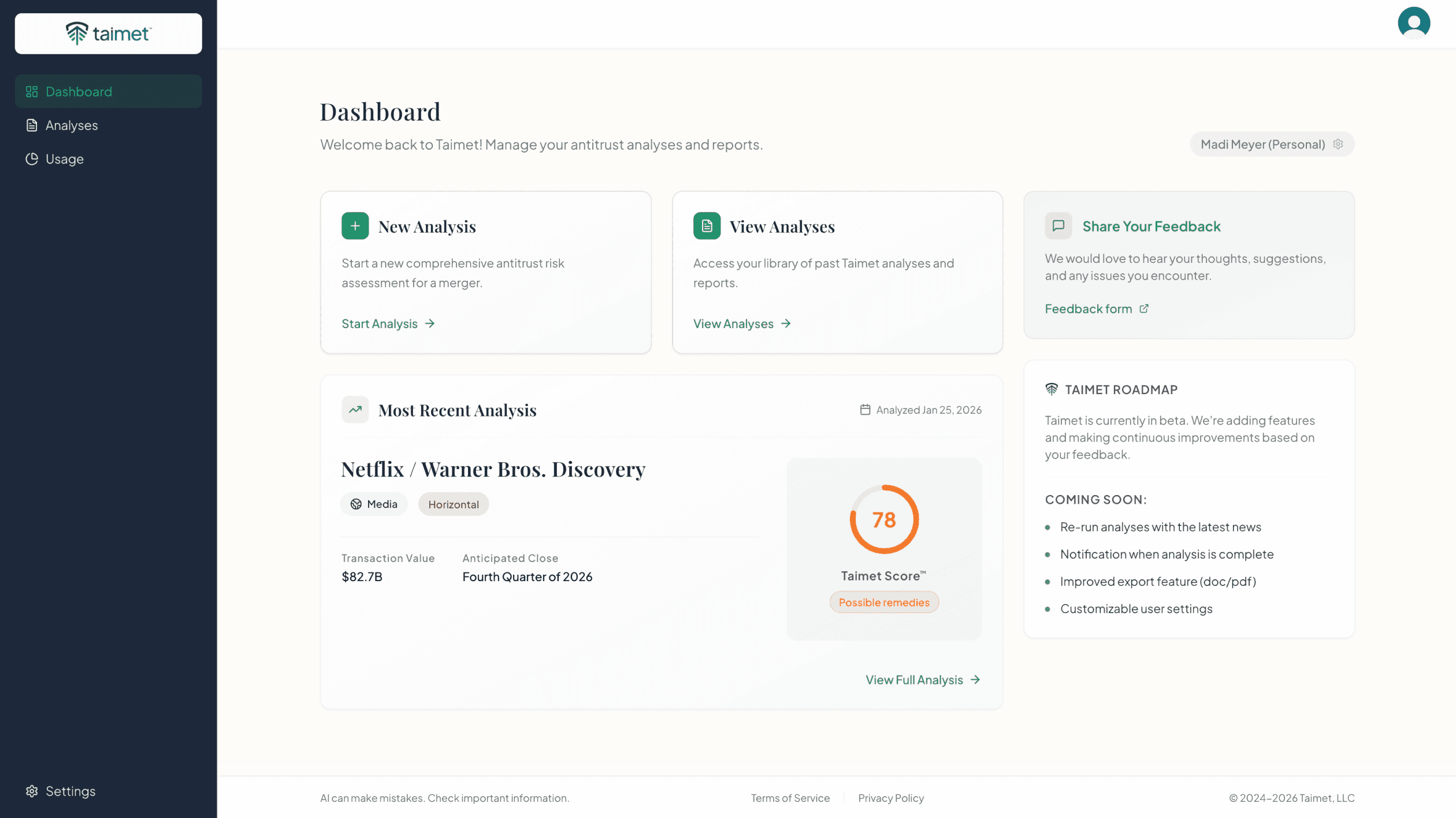
Information Design
Taimet is an AI-powered antitrust analysis tool. It takes a merger, runs it through a custom LLM, and produces a full risk assessment in about 30 minutes. The same analysis takes a human paralegal 10 to 15 hours.
How do you design an AI product that experts in a high-stakes legal domain will actually trust, understand, and act on?
My work over 12 weeks centered around one question:
CONTEXT
THE CHALLENGE
85
HIGH RISK
Possible challenges by federal agencies
DOC
TXT


The biggest theme I kept hearing from the founder was trust. Taimet's model only works if users believe it can match the quality and accuracy of the analysis they'd do themselves, but quicker.
WHY I STARTED HERE
PROCESS
AI Trust Framework
1
2
3
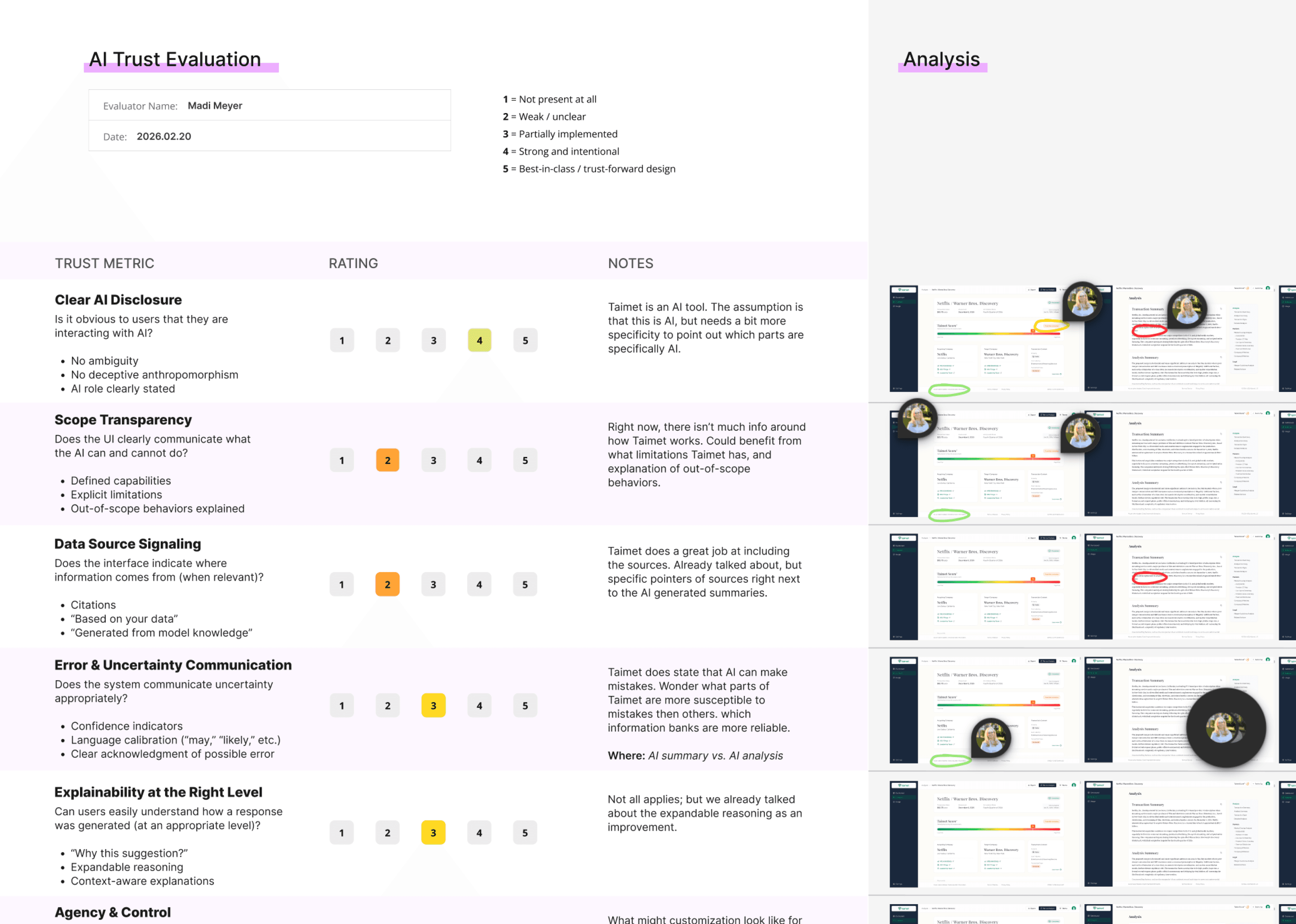
Literature review on AI product & trust standards
Adapt standards to create specific framework
Evaluation + suggestions
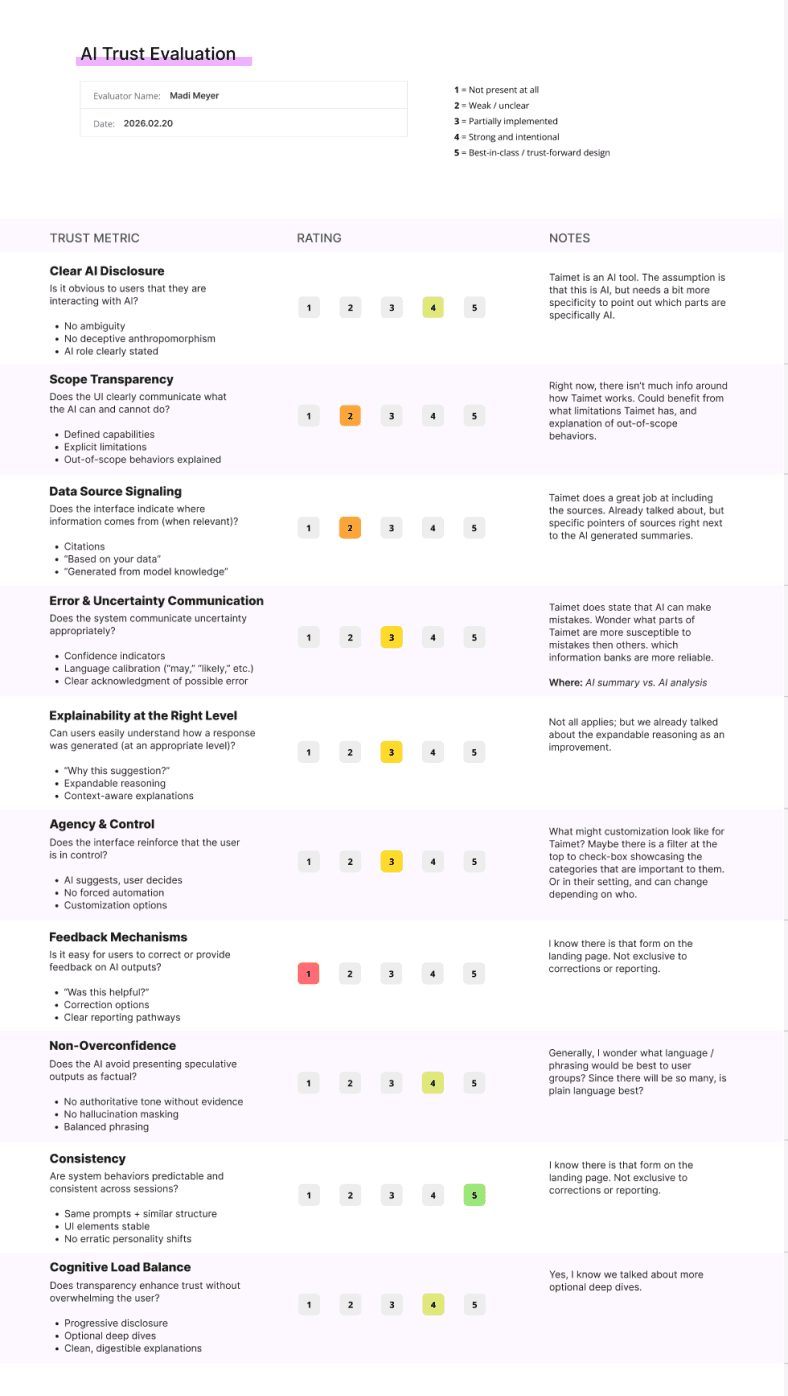
Researched authoritative frameworks for trustworthy AI. Landed on NIST's AI Risk Management Framework and its seven characteristics of trustworthy AI.
Translated NIST's seven characteristics into plain-language evaluation criteria: a quick, repeatable tool the team could use again as the product evolves.
Audited Taimet against the framework, identified gaps in scope transparency and data source signaling, and proposed targeted design fixes.
Taimet had clear gaps in:
WHAT I FOUND
Scope transparency
Data source signaling
Users couldn't easily see what Taimet could do, what it couldn't do, or what was explicitly out of scope.
When Taimet made a claim, it wasn't always clear whether that claim came from a cited source or the model.
RECOMMENDATIONS
An "About this AI" page
Inline citations + article previews
This addresses scope transparency directly. It also gives Ben a single place to evolve the product's self-description as Taimet's capabilities change.
This addresses data source signaling. It lets users move from "trust the AI" to "trust the AI because I can verify it in two clicks."

About this AI
About this AI
What is Taimet?
What Can It Do?
Where Does the Information Come From?
How Confident Should You Be?
Taimet is an AI-powered tool that analyzes mergers for their antitrust risk — delivering fast, consistent, and expert-level assessments for regulators, law firms, and investment firms. Delivering fast, consistent, and expert-level assessments for regulators, law firms, and investment firms.
Taimet is an AI-powered tool that analyzes mergers for their antitrust risk — delivering fast, consistent, and expert-level assessments for regulators, law firms, and investment firms.
Taimet is an AI-powered tool that analyzes mergers for their antitrust risk — delivering fast, consistent, and expert-level assessments for regulators, law firms, and investment firms.
Taimet is an AI-powered tool that analyzes mergers for their antitrust risk — delivering fast, consistent, and expert-level assessments for regulators, law firms, and investment firms.
Taimet is an AI-powered tool that analyzes mergers for their antitrust risk — delivering fast, consistent, and expert-level assessments for regulators, law firms, and investment firms.
What Can't It Do?
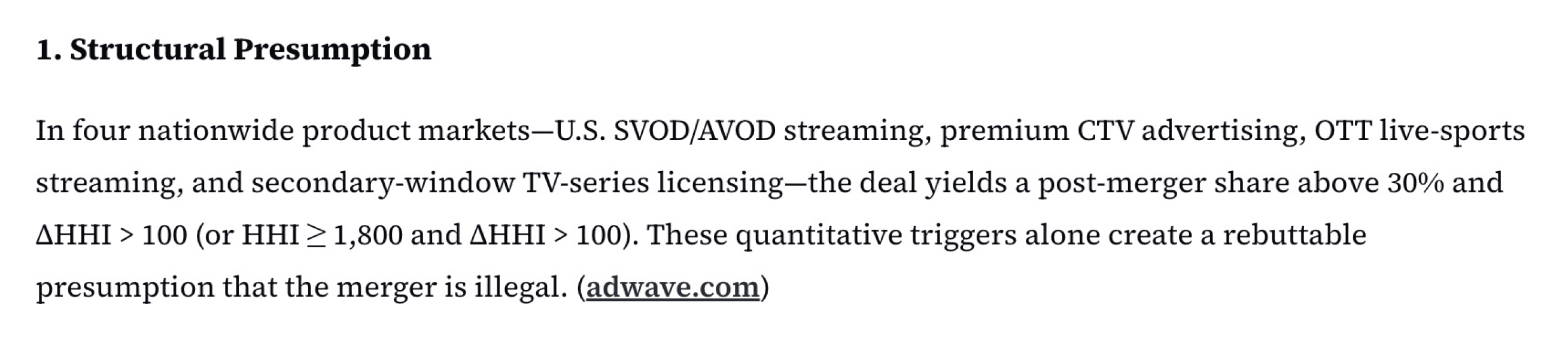
CTV Advertising Costs: What Small Businesses Actually Pay
adwave
CTV CPMs average $25, but range from $15-35 depending on targeting and platform.

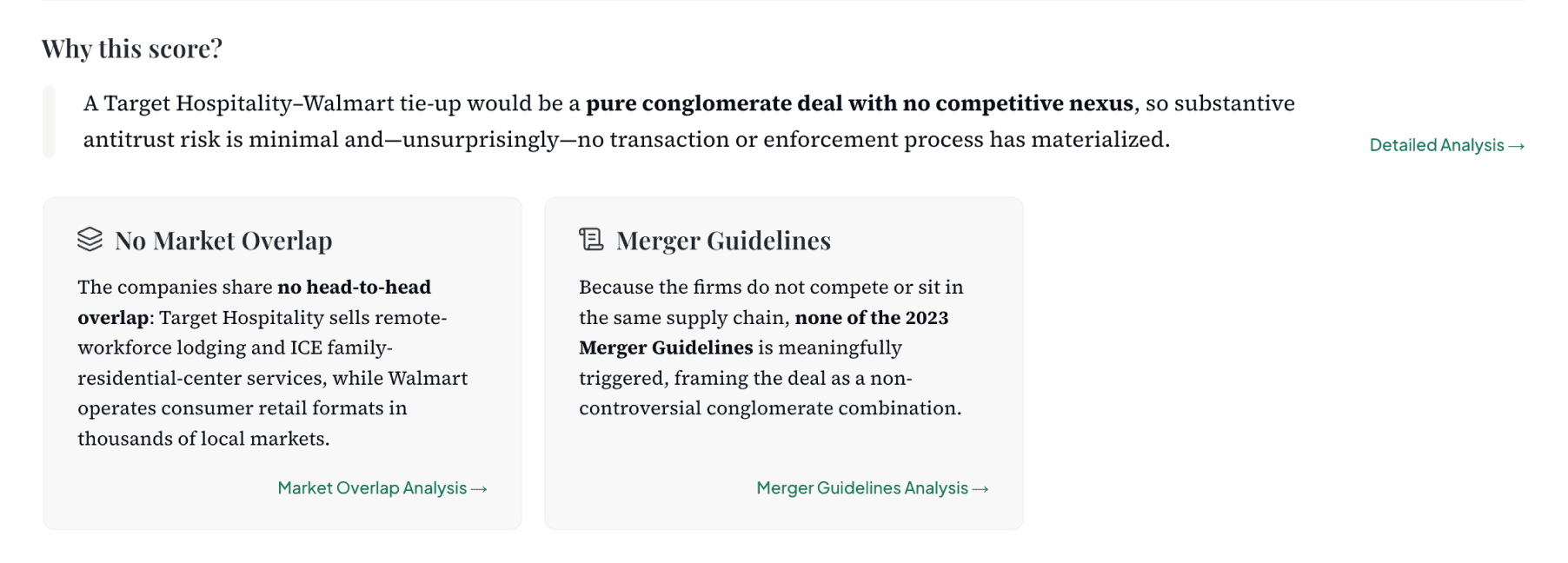
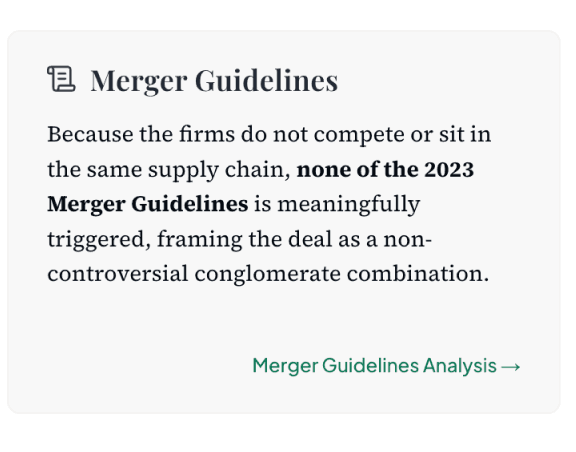
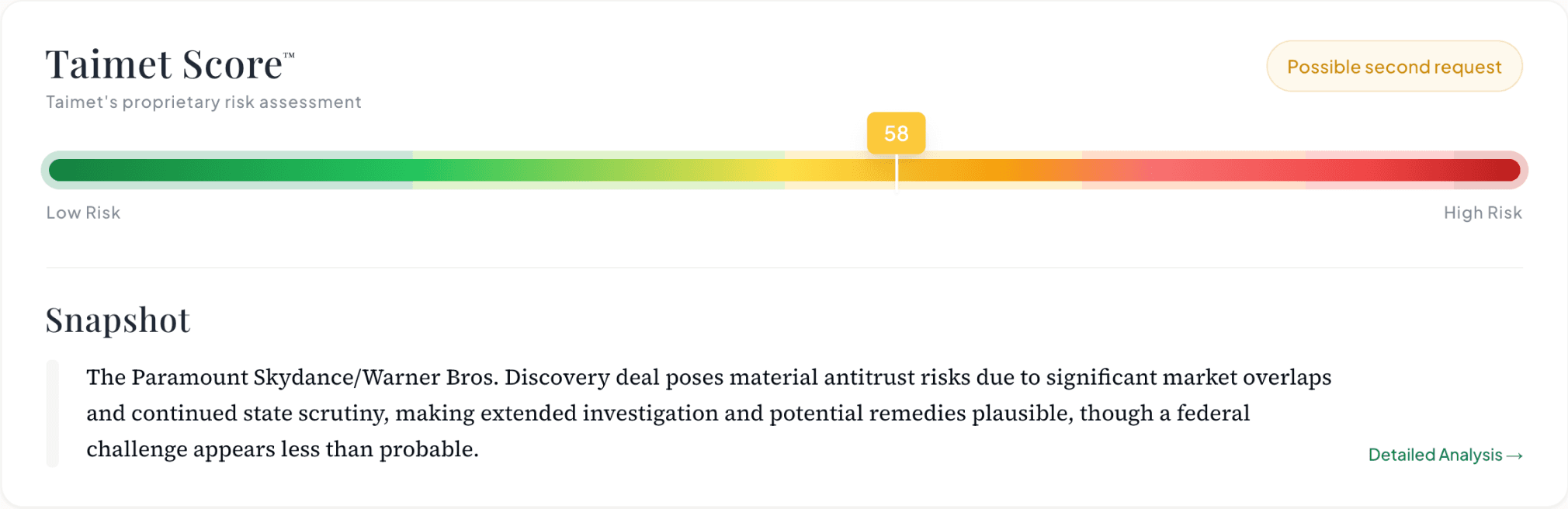
The 0–100 risk score is one of Taimet's most valuable outputs, the thing users look at first and act on. If users can't understand what the number represents, the number isn't doing its job.
WHY I STARTED HERE
Score Visualization
Before anything, I broke the score into the three distinct layers of information:
LAYERS OF INFORMATION
range 0–100
interpretive tagline
reasoning behind why the score landed where it did
Label
Score
Explanation
PROCESS
1
2
3
Research
Layer the score
Mock-up + suggest
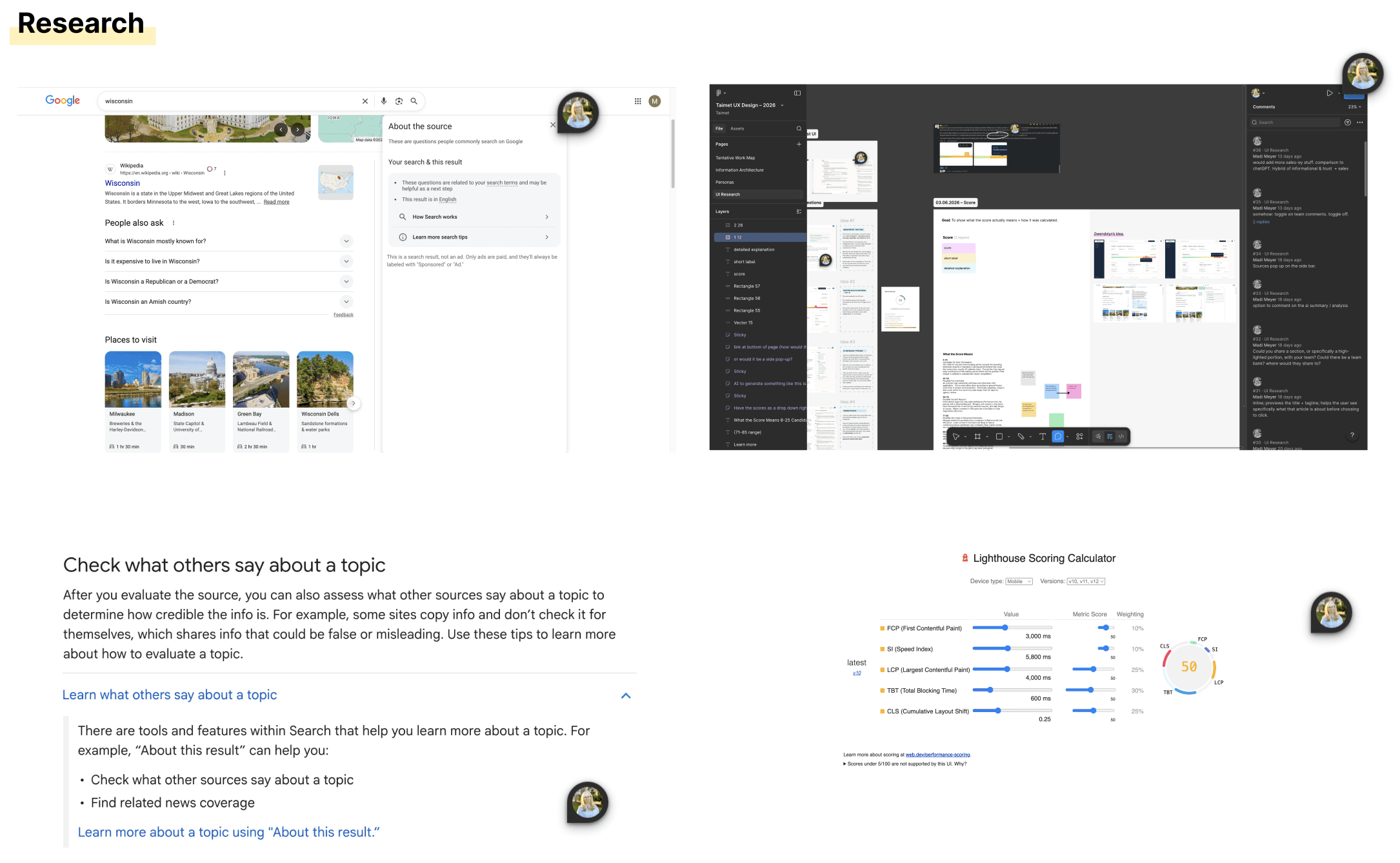
Looked at how other AI products and data-heavy interfaces communicate scored or layered information without overwhelming the user.
Defined the three information layers (score, label, explanation) ,and mapped what each one needs to do for the user.
Explored different placements and visual treatments for each layer, then proposed final directions for how the three should sit in the interface.
RECOMMENDATIONS
FINAL DESIGN
Tooltip below the score bar would allow the score to stay visible above the bar.
Transparency around how the score is calculated.
More information on all the score ranges.
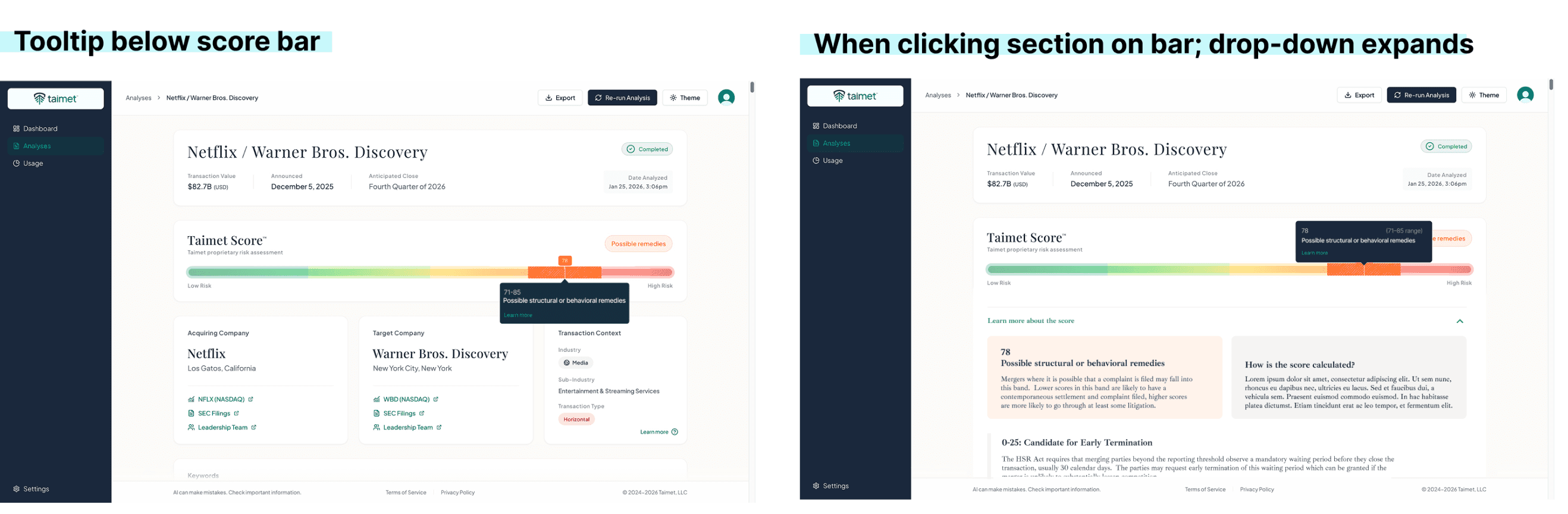
Learn more about the score
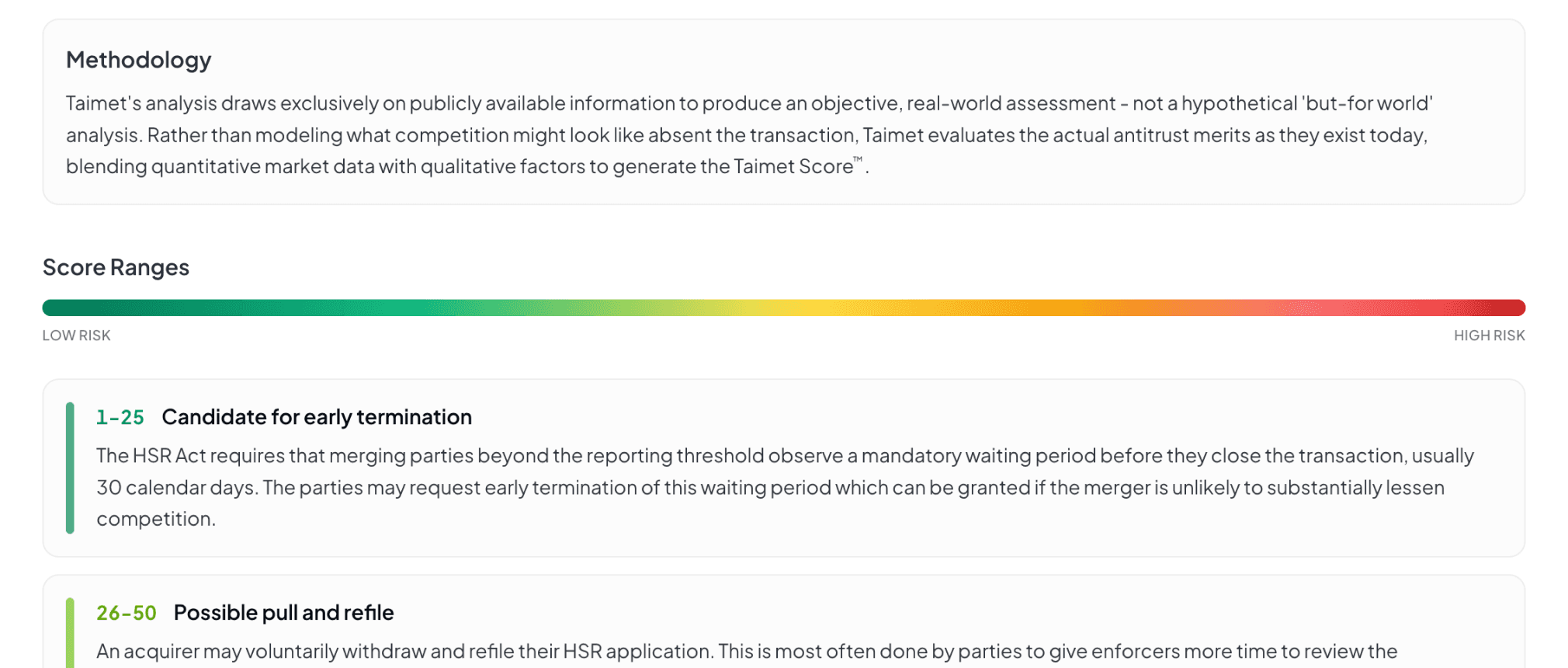
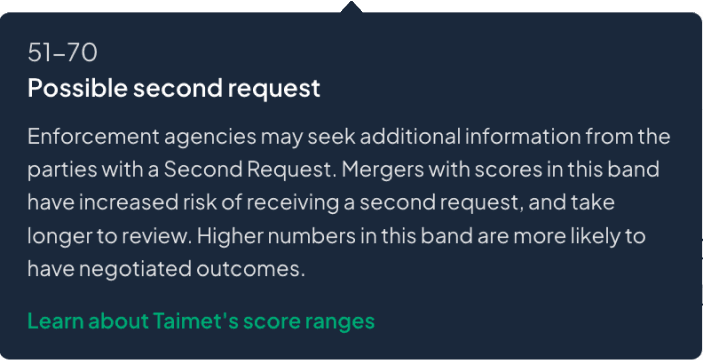
Most important information at the top, supporting detail below
Influential sources in the section pulled to the top.
Show section titles by default, expand for detail.
Using iconography is indicate where there is high risk information.
Taimet had a ton of text, with little variation in hierarchy, break, and differentiation. It was difficult for users to skim through and find key information relevant to them.
WHY I STARTED HERE
Progressive Disclosure in Reporting
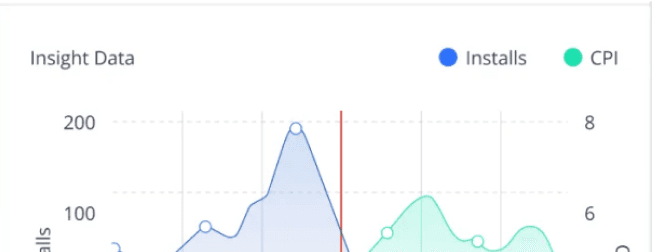
I evaluated three progressive disclosure patterns against Taimet's needs:
EXPLORATION
Summary-First
(inverted pyramid)
Summary
Lorem ipsum dolor sit amet, consectetur adipiscing elit. Pellentesque justo dui, molestie malesuada mattis quis, iaculis et lorem. Nunc malesuada faucibus turpis, at tempor libero.
Expandable Sections
Topic
Lorem ipsum dolor sit amet, consectetur adipiscing elit. Pellentesque justo dui, molestie malesuada mattis quis, iaculis et lorem. Nunc malesuada faucibus turpis, at tempor libero.
Section title
Section title
Section title
Section title
Lorem ipsum dolor sit amet, consectetur adipiscing elit. Pellentesque justo dui, molestie malesuada mattis quis, iaculis et lorem. Nunc malesuada faucibus turpis, at tempor libero.
Filter
Action
Choice
Input
Defined-View Filtering (role-based)
I recommended expandable sections with summaries shown first.
RECOMMENDATION
!
!
CTV Advertising Costs: What Small Businesses Actually Pay
adwave
CTV CPMs average $25, but range from $15-35 depending on targeting and platform.

CTV Advertising Costs: What Small Businesses Actually Pay
adwave
CTV CPMs average $25, but range from $15-35 depending on targeting and platform.
CTV Advertising Costs: What Small Businesses Actually Pay
adwave
CTV CPMs average $25, but range from $15-35 depending on targeting and platform.
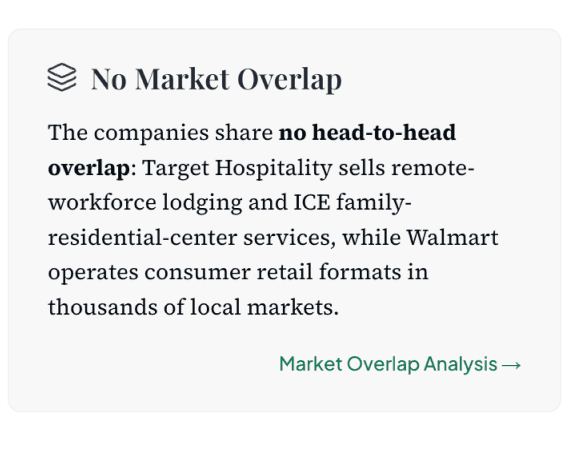
Premium CTV Ads
Market Overlap Analysis
Live-Sports Streaming
Scripted-Series Licensing
Theatrical Distribution
Company A Markets
Nullam pretium non lacus sed lacinia. Morbi porttitor mauris lectus, a convallis ipsum accumsan vel. In porta nisl non dignissim bibendum. Cras in interdum nibh. Sed lorem magna, eleifend ut orci in, consectetur vehicula metus. Integer sed vulputate metus, in sagittis ipsum. Nunc faucibus cursus enim at semper. Lorem ipsum dolor sit amet, consectetur adipiscing elit. Proin sed magna eget nisi lobortis tincidunt. Vivamus eleifend tellus sit amet arcu tincidunt.
Summary
Top Sources
CTV Advertising Costs: What Small Businesses Actually Pay
adwave
CTV CPMs average $25, but range from $15-35 depending on targeting and platform.
CTV Advertising Costs: What Small Businesses Actually Pay
adwave
CTV CPMs average $25, but range from $15-35 depending on targeting and platform.
CTV Advertising Costs: What Small Businesses Actually Pay
adwave
CTV CPMs average $25, but range from $15-35 depending on targeting and platform.
!
!
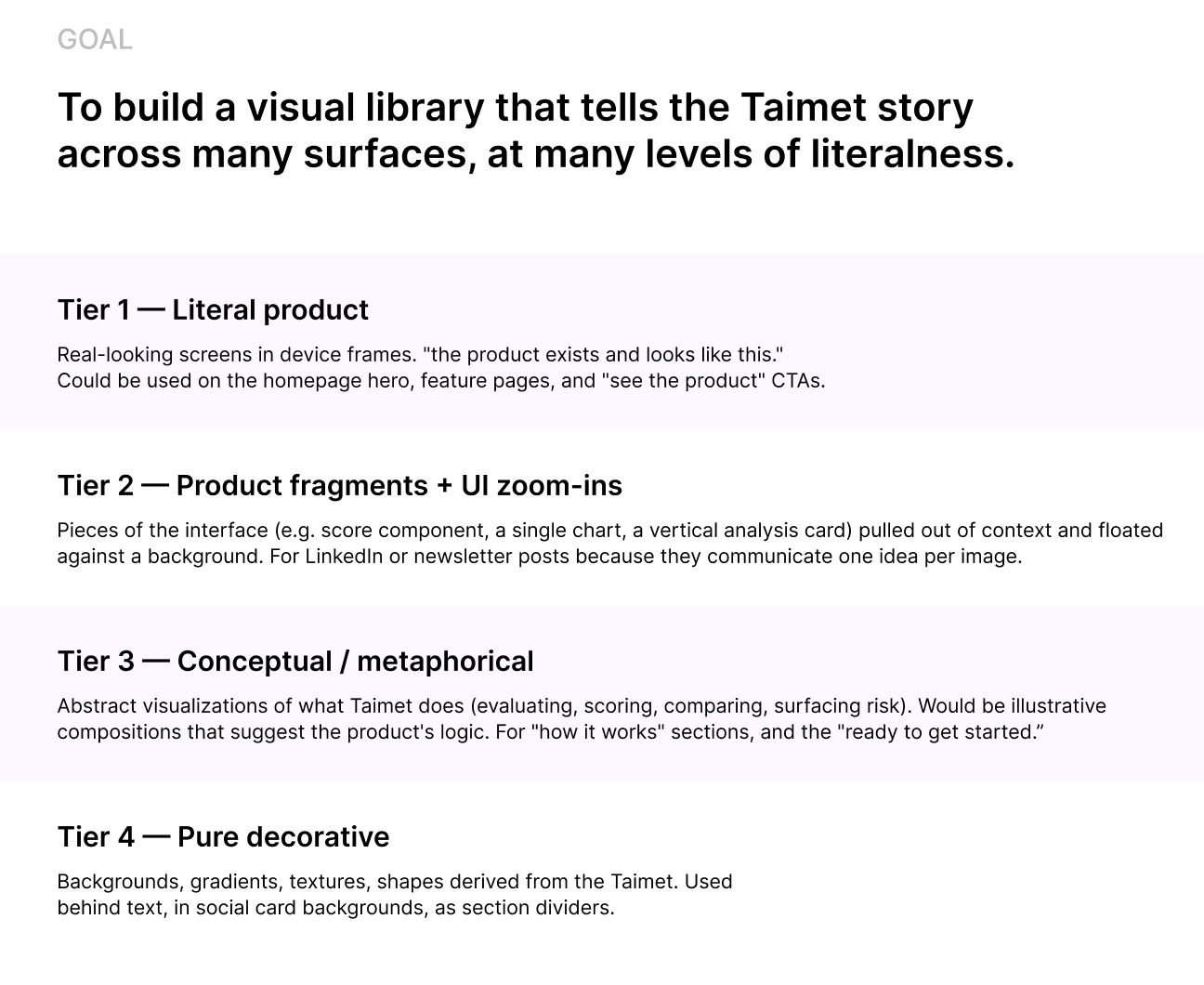
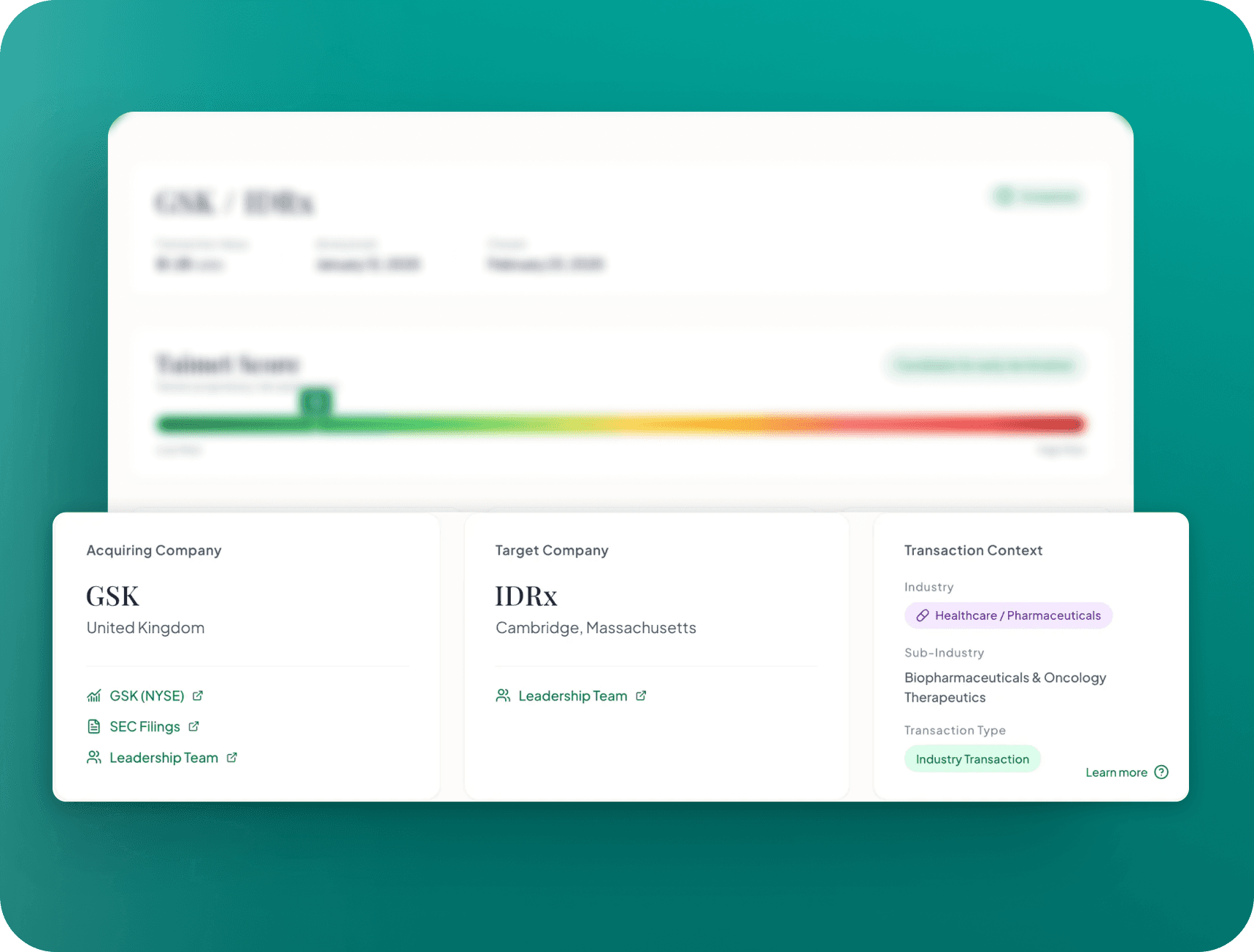
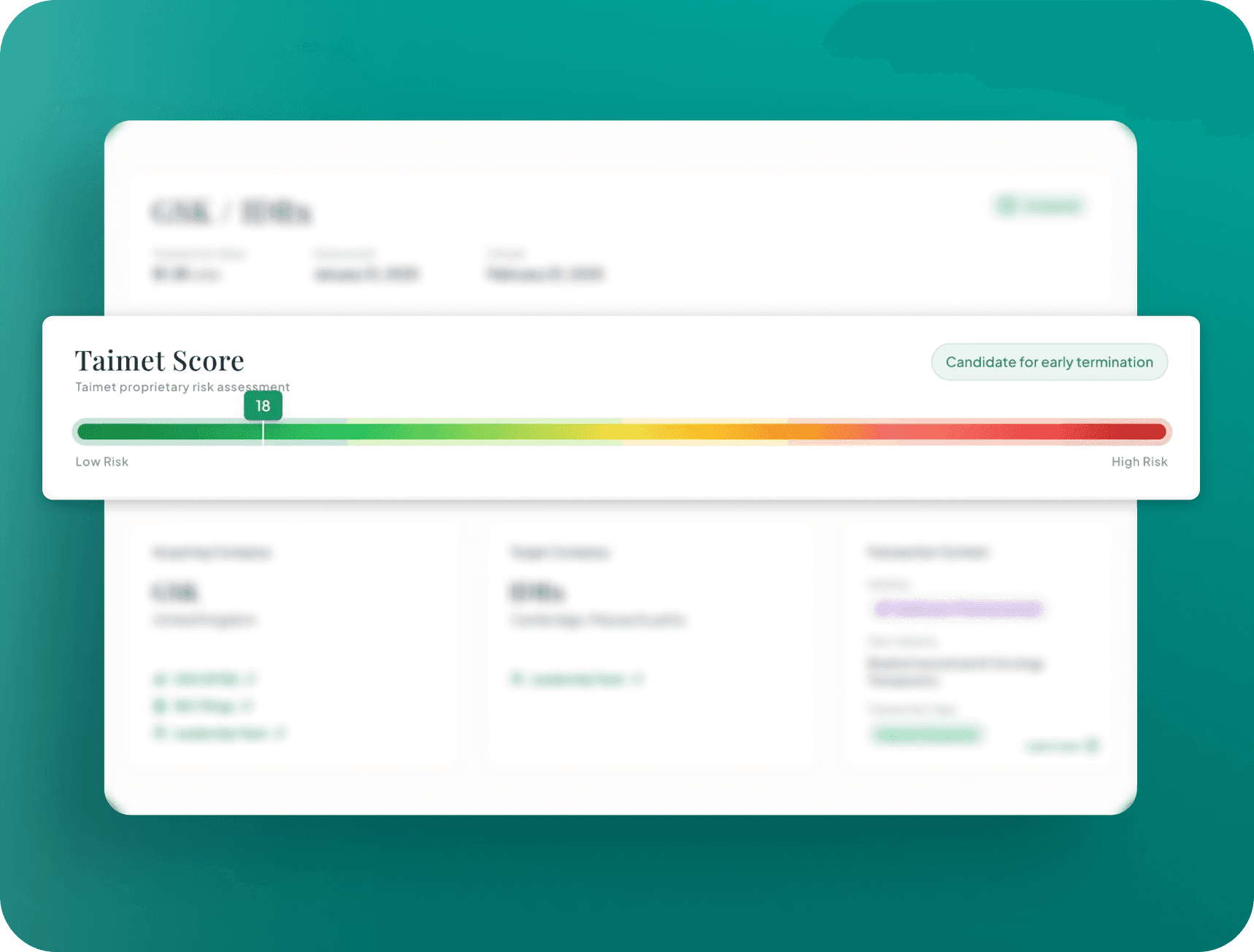
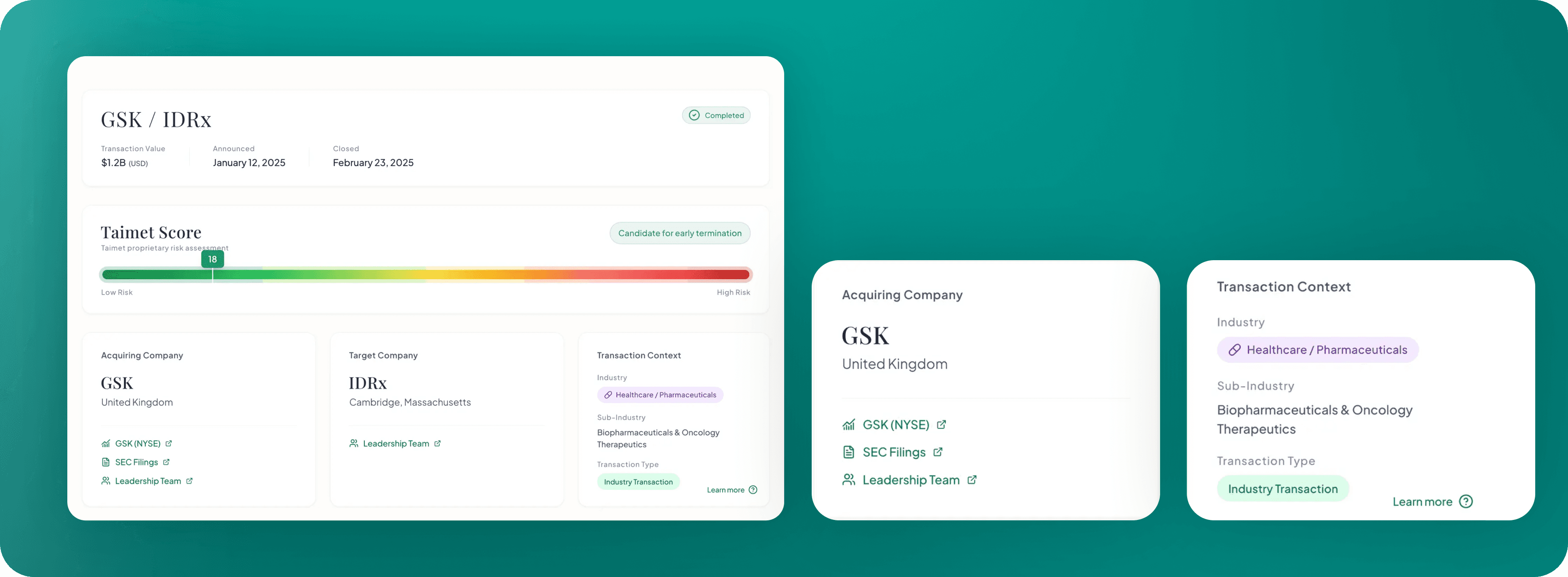
"create 5 to 5,000 images we can use for marketing and telling the story of our product." -- Founder’s ask
WHY I STARTED HERE
STRATEGIZING
NARROWING SCOPE
GRADIENTS
REUSABLE MOCK-UP SYSTEM
Product Marketing Visuals
Gradient Backgrounds

Re-usable template
That was a lot of ambiguity.
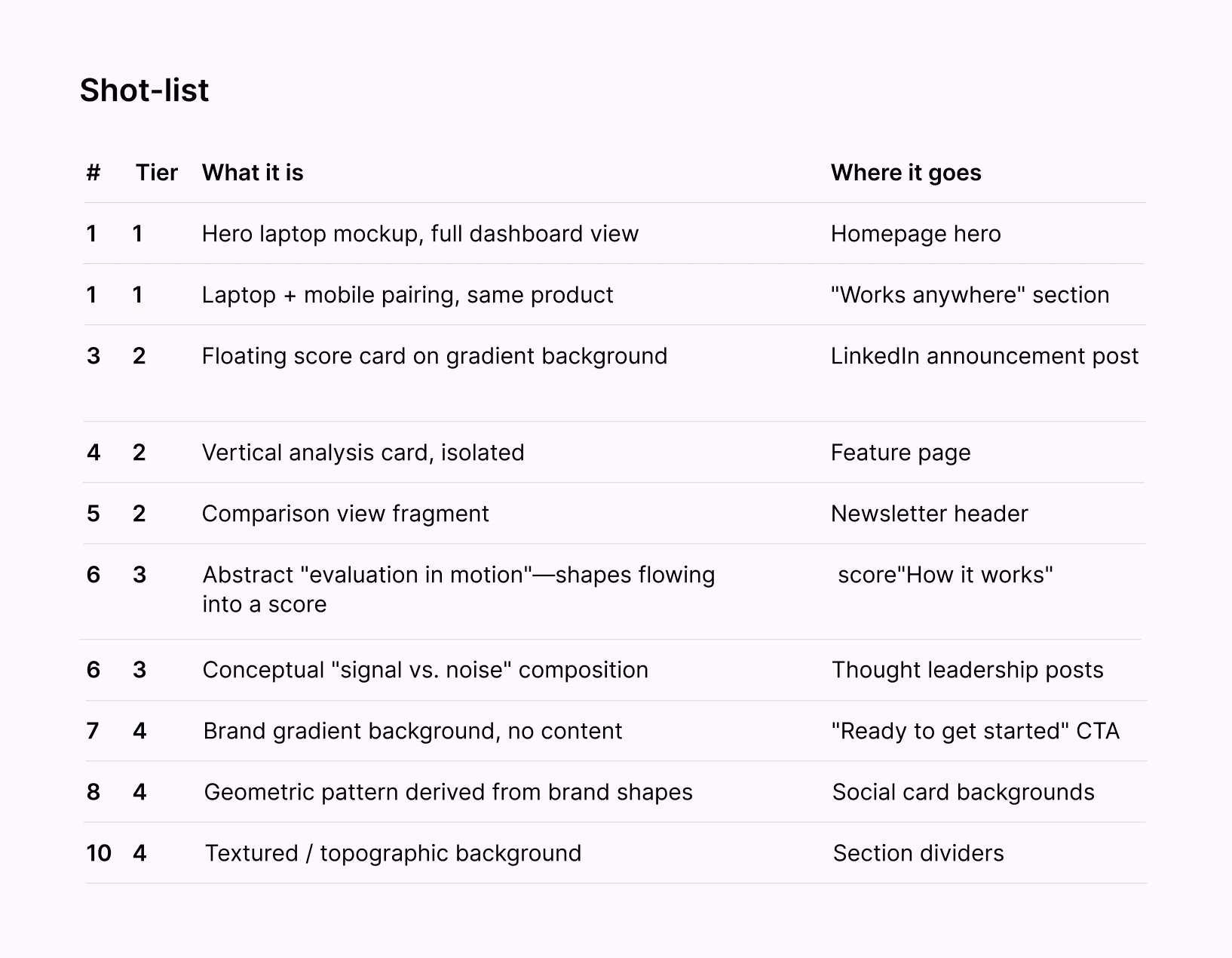
From the tiers, I built a shot list, with each entry mapping to a specific surface (homepage hero, LinkedIn announcement, newsletter header, etc.).
I used Claude to break the visual library into four tiers, each operating at a different level of literalness.
1
2

Increased AI product trust
Visualization improvements
Report legibility
OUTCOME & REFLECTION
Delivered four assets the startup team can continue using and iterating on: a custom AI trust evaluation framework, score visualization recommendations, progressive disclosure improvements, and a Visual Brand Operating System.
What was the impact for the startup?
What would I do differently next time?
This project made me clearer about what I'm strongest at, and where I'm still growing. Visual design isn't a core strength of mine yet, and trying to lead it stretched the timeline and the quality of the output.
Knowing that now, I'll upfront in future work, and lean toward the strategic, systems-level design where I do my best thinking.